- PrivateEquityGuy
- Posts
- Serial Acquirers, Stockholm & NYC
Serial Acquirers, Stockholm & NYC
160 acquisitions in 9 years ($1.5B in revenue)

PrivateEquityGuy
March 16, 2026
Buyers and Builders,
This past week I attended Redeye’s Swedish Serial Acquirers event in Stockholm.
My main takeaway is that long-term success often comes from consistency rather than from brilliance and being okay to slow first to allow you to go fast later.
Over the long run, those that completed 1-2 acquisitions per year in the early years tended to outperform those that pursued a faster pace, such as 4-6 deals per year.
The key is to get the strategy right...to find product market fit in your acquisition approach to be able to scale from a solid foundation.
These are reflections from the investor panel, where Andrew Hollingworth of Holland Advisors, Christian Solberg of Sun Mountain Partners, and David Marcus of Evermore Global Advisors shared their perspectives.

One of the biggest reasons they get excited about serial acquirers:
They solve the reinvestment problem.
In most businesses, good reinvestment opportunities are limited. You fund the core projects, maybe expand capacity, invest in products and after that, the incremental dollar usually earns a lower return.
Cash starts to pile up.
Owners either return cash to shareholders or start stretching into lower-quality projects just to put the money to work.
Serial acquirers work differently.
Instead of relying only on internal projects, they build a repeatable machine to acquire businesses that meet strict return thresholds.
Do it well and you create a long runway to keep deploying capital.
The cash doesn’t sit on the balance sheet.
It gets recycled into the next acquisition. And the next one.
In the best cases, the model allows you to reinvest close to 100% of free cash flow at high rates of returns for many years, even decades.
-
I’d sum the investor perspective part with a story of a woman who invested in one of the serial acquirers 50 years ago.
She has generated a 7,500x return.
That equates to a 20% CAGR since 1976.
She still owns the shares today.
Her take has been very clear: “Why should I sell?”
-
A few weeks ago, I spoke with Travis Jamison, co-founder of CapitalPad. (We recorded the full conversation, and it has already been viewed by more than 4,000 people on YouTube.)
After building and exiting multiple companies, Travis and his team set out to create a platform focused on profitable, so-called “boring” businesses in the $2M to $15M EBITDA range.
His view is that the lower middle market remains one of the most attractive asset classes available. To date, they have completed 10 acquisitions and are currently pursuing two live deals, each with a projected IRR of 25% or more.
For accredited investors, there is an opportunity to invest alongside them.
That said, while the current live deals are underwritten to projected IRRs of 25% or higher, there are, of course, no guarantees in investing.
You can review the opportunity yourself at CapitalPad.com
CapitalPad is also a sponsor of this newsletter, so this is not investment advice, and you should conduct your own due diligence.

- One of the final presentations at the conference was delivered by Jeff Totten, Co-Founder and CEO of Evergreen Services Group (backed by Alpine Investors).
Listening to their story from those young co-founders, they were 25 and 27 when they started, Evergreen might be one of the most interesting HoldCo stories in America.
Evergreen is building something that very few people fully appreciate. On the surface, Evergreen is “just” a serial acquirer in technology services (think IT managed service providers and application software companies).
In reality, they are building a decentralized compounding machine.
Since starting in 2017, Evergreen has completed 160 acquisitions, grown to roughly $1.5 billion in revenue and about $250 million in adjusted EBITDA, while still putting up around 10% organic growth. Those numbers alone are impressive. But the real story is how they are doing it.
Ramsey Sahyoun (Co-Founder and Head of M&A) was kind enough to say yes to joining the Buyers & Builders podcast soon.

One thing Ramsey said during our conversation was he’s forever thankful for Alpine Investors (they’re previous employer); when they decided to leave, Alpine stepped in to back their next project, which today is Evergreen. (note: Alpine still owns the majority.)
“It’s been one acquisition and one key hire at a time.”
Now, let’s describe their model, which is simple to describe but very hard to replicate.
They buy and hold businesses indefinitely. They keep the structure decentralized. They preserve the identity of the companies they acquire. And then they layer in what Jeff called the real economic engine: M&A, talent and playbook.

That triad seems to be the key.
The first leg is obvious: they are exceptional acquirers. Evergreen has built specialized M&A teams, strong relationships with founders, and a proprietary sourcing engine. The majority of their acquisitions appear to be off-market, which matters. In any roll-up, proprietary deal flow is one of the clearest signs that the company has become a preferred home for sellers rather than just another bidder in an auction.
The second leg is more important than most people realize: talent. Evergreen is not only buying companies. They are recruiting leaders, placing operators, and building a bench that can scale across the portfolio. They have placed talent in more than 80% of acquisitions. That tells you this is not a passive capital allocator. It is an operating HoldCo that understands the biggest bottleneck in scaling service businesses is usually leadership.
The third leg is the playbook. This is where serial acquirers separate themselves from ordinary consolidators. Evergreen is not trying to centralize everything. They are trying to create repeatable methods that local operators can use to grow faster, improve margins, and serve customers better. That includes go-to-market initiatives, service delivery improvements, and increasingly AI-driven experimentation inside the portfolio.
That last point stood out to me.
A lot of companies talk about AI in vague, promotional language. Evergreen’s framing was much more practical. They see AI as a tool to expand value proposition, scale service delivery, and create new revenue streams. In other words, they are thinking like operators. Use AI to automate workflows, improve ticket routing, launch advisory services, and reimagine delivery models.

Another thing I found interesting is how directly Jeff positioned Evergreen relative to the Swedish serial acquirers. At the end of his presentation, he openly acknowledged the inspiration.
The shared DNA is clear: decentralized operations, long-term ownership, strong cash flow orientation, and a belief in organic growth on top of acquisitions. But Evergreen is also building its own distinct version of the model. Unlike many of the Swedish DSAs, they are pursuing a higher-velocity M&A strategy, focused specifically on technology services, and they are reinvesting 100% of free cash flow back into growth rather than emphasizing dividends.
That makes Evergreen feel less like a copy and more like an American evolution of the model.
The current operating structure also shows real intentionality. Evergreen sits at the HoldCo level with a relatively lean team, and beneath it are focused operating groups like Lyra, Pine, and Cedar. Each has its own niche inside technology services. Lyra is a technology managed services provider for SMBs. Pine focuses on cloud ERP managed services. Cedar serves government agencies with technology solutions. This is not intentional diversification. It is a portfolio being built around adjacencies inside a broad and growing technology services market.
And that market is massive.

The slide on market opportunity framed Evergreen’s current scale against a huge global technology services TAM, supported by secular tailwinds like AI adoption, cloud migration, cybersecurity, connected devices, and increased outsourcing.
Evergreen’s $1.5B in sales, Global MSP (Managed Service Provider) $360B and Global Technology Services market being $1.4T.
That is what makes the model especially compelling: this is not a roll-up in a stagnant industry. It is a roll-up in a fragmented market that is still growing underneath them.
The performance slide may have been the most impressive part of the whole presentation.

The EBITDA chart showed a business that did not spike from one transformative deal. It climbed steadily, quarter after quarter, through phases: building the foundation, high-pace MSP M&A, expansion into multi-vertical, and now organic growth plus international scale.
Evergreen is not merely buying revenue. They are trying to build the best permanent home for technology services businesses and their leaders.
The best serial acquirers understand that their true product is not capital. Their true product is being the most attractive long-term destination for great companies, founders, and operators. That seems to be exactly how Evergreen thinks.
If they can continue to combine proprietary M&A, operator density, and playbook-driven organic growth, this could become one of the most important HoldCo stories to study in the next decade.
And the most exciting part for me personally, again: Ramsey, Evergreen’s other co-founder, is coming on the podcast soon.
That should be a fascinating conversation.
-
To give you a deep dive into the world of serial acquisitions, I invited Niklas Savas, a former analyst at Redeye (now VP Business Development and M&A at Lagercrantz), who has a unique perspective on the Swedish serial acquirers' approach.
Few people have studied the Swedish serial acquirers as closely, and even fewer have operated inside that playbook.
-Addtech AB: More than 150 companies, approximately $2.3Bin revenue, and $348M in EBITA.
-Lagercrantz Group AB: More than 80 companies, with over $1.1B in annual revenue and approximately $148M in EBITA.
-Lifco AB: 275 operating companies, approximately $3.0B in revenue, and $674M in EBITA.
-Teqnion AB: About 25 niche subsidiaries, approximately $192M in revenue, and $22M in EBITA.
-Röko: A portfolio of 30 business units, with approximately $688M in revenue and $143M in adjusted EBITA.
Niklas discusses how growth through mergers and acquisitions (M&A) can open doors to expansive growth, and how Swedish serial acquirers have mastered the art of driving up prices and maintaining high P/E ratios. We also explore the realities of post-acquisition management, the competitive landscape of deal-making, and the advantages of being sector-agnostic.
With his extensive analysis of businesses and focus on expansion, Niklas paints a picture of how acquisitions can fuel long-term growth.
Although this conversation was recorded a year ago, the principles remain highly relevant. I think you’ll find the lessons enduring and worth studying closely.

Here are the links to Spotify, Apple Podcasts, and YouTube.
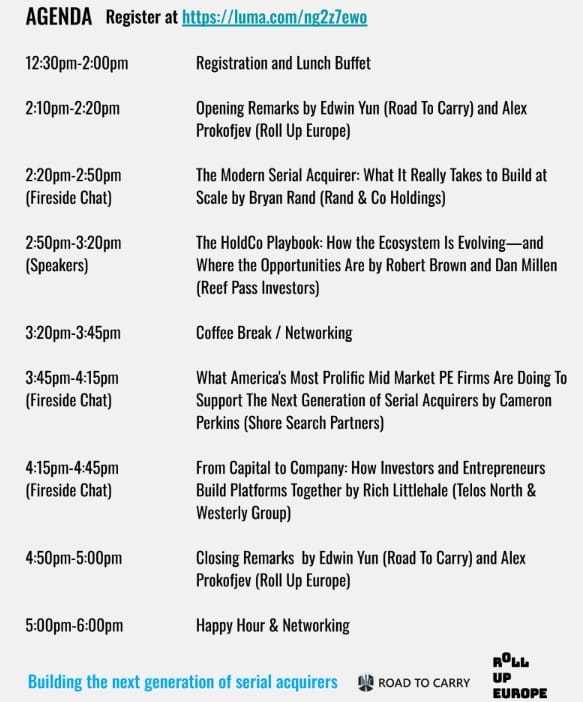
Lastly, on March 31, I will be attending another Serial Acquirers event, this time in New York City. The event is sold out, but there is a waitlist (join the waitlist here). If any registered attendees are unable to attend, those spots will be made available to individuals on the waitlist.

Click to join the waitlist
Click to join the waitlist
That’s all for this week.
Take care,
Mike Markus / PrivateEquityGuy